
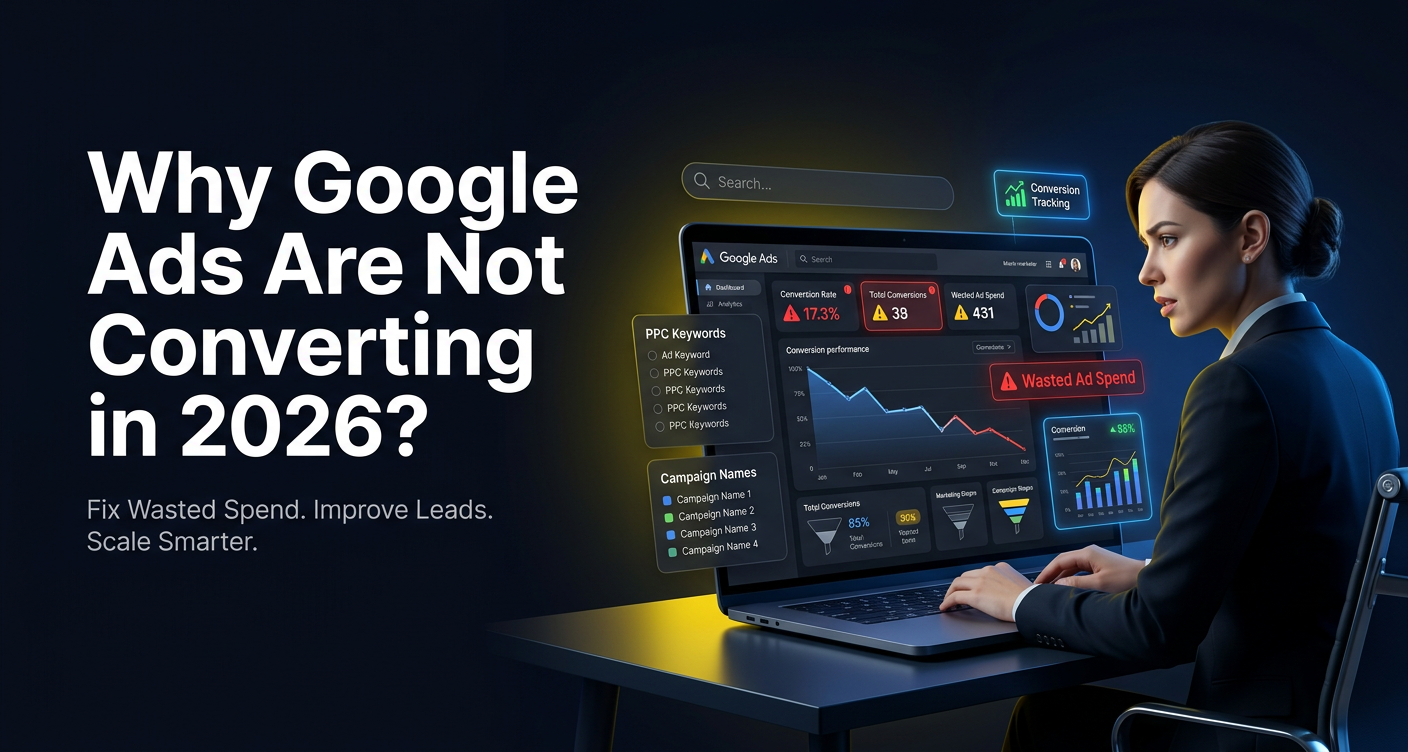
Why Google Ads Are Not Converting in 2026 (And How to Fix It)
Running Google Ads but not getting leads or sales is one of the most common problems businesses face in 2026. Many companies spend thousands on ads yet struggle with low conversions, high CPC, poor-quality leads, or zero ROI.
The issue is usually not Google Ads itself. The real problem is poor strategy, weak landing pages, wrong targeting, or misunderstanding user intent.
This guide explains the major reasons why Google Ads campaigns fail to convert and how businesses can fix them.
What Does “Conversion” Mean in Google Ads?
A conversion can be:
- A lead form submission
- A phone call
- A purchase
- A WhatsApp inquiry
- A signup
- A booking
- A download
If users click ads but do not complete the desired action, the campaign is not converting properly.
Main Reasons Why Google Ads Are Not Converting
1. Wrong Keyword Targeting
This is one of the biggest reasons for wasted ad spend.
Many businesses target:
- Broad keywords
- High-competition keywords
- Irrelevant searches
Example:
Bad keyword:
- “marketing”
Good keyword:
- “local SEO agency for dentists”
- “Google Ads expert in Delhi”
- “Shopify SEO services”
Specific intent keywords usually convert better.
2. Search Intent Mismatch
A user’s intent matters more than traffic volume.
Example:
Someone searching:
- “What is SEO?”
is usually informational.
Someone searching:
- “hire SEO agency”
has buying intent.
Many businesses target informational keywords while expecting sales.
3. Weak Landing Pages
Even excellent ads fail if landing pages are poor.
Common landing page problems:
- Slow loading speed
- Weak design
- Too much text
- No CTA
- Confusing layout
- Poor mobile experience
- No trust signals
A high-converting landing page should include:
- Clear headline
- Strong CTA
- Benefits
- Reviews/testimonials
- Contact form
- Mobile optimization
- Fast speed
4. Poor Ad Copy
If ad copy does not match user intent, conversions drop.
Bad ad copy:
“Best Digital Services”
Better:
“Get More Leads with ROI-Focused Google Ads Management”
Strong ads usually include:
- Problem
- Solution
- Benefit
- CTA
5. No Conversion Tracking
Many businesses run ads without proper tracking.
Without tracking, you cannot know:
- Which keywords convert
- Which ads work
- Which audience performs best
- Actual ROI
Important tracking setup:
- Google Tag Manager
- GA4
- Conversion events
- Call tracking
- Form tracking
6. Low-Quality Traffic
Not all clicks are valuable.
Problems often come from:
- Wrong locations
- Broad audience targeting
- Irrelevant search terms
- Display network waste
- Bot traffic
Use:
- Negative keywords
- Audience exclusions
- Geo-targeting
- Search term analysis
7. Poor Mobile Optimization
Most Google Ads traffic now comes from mobile devices.
If the mobile experience is poor:
- Users leave quickly
- Bounce rate increases
- Conversion rate drops
Important mobile factors:
- Fast loading
- Easy forms
- Clickable buttons
- Responsive design
8. High CPC but Low Buyer Intent
Some industries have expensive keywords with weak conversion potential.
Businesses often target:
- High-volume keywords
- instead of:
- High-converting long-tail keywords
Example:
Bad:
- “SEO services”
Better:
- “affordable SEO services for ecommerce stores”
Long-tail keywords usually convert better.
9. Weak Offer
Sometimes ads fail because the offer itself is weak.
Users ask:
- Why should I choose you?
- What makes your service different?
- What problem are you solving?
Weak offers:
- Generic promises
- No differentiation
- No urgency
Strong offers:
- Free audit
- Free consultation
- ROI-focused service
- Case studies
- Guaranteed response time
10. Lack of Trust Signals
Users rarely convert on websites that look untrustworthy.
Important trust elements:
- Testimonials
- Client reviews
- Real portfolio
- Contact details
- HTTPS security
- Company information
- Google reviews
- Case studies
Trust significantly impacts conversion rates.
11. Poor Audience Targeting
Audience quality matters more than traffic quantity.
Businesses often target everyone instead of ideal buyers.
Good targeting includes:
- Location targeting
- Device targeting
- Demographics
- Custom audiences
- Remarketing audiences
12. No Remarketing Strategy
Most users do not convert on the first visit.
Remarketing helps bring users back.
Effective remarketing:
- Display ads
- YouTube remarketing
- Dynamic ads
- Offer reminders
- Abandoned cart campaigns
Remarketing often produces higher ROI than cold traffic.
13. Low Ad Relevance Score
Google evaluates:
- Keyword relevance
- Ad quality
- Landing page experience
- CTR
Poor Quality Score increases CPC and lowers performance.
To improve:
- Match keywords to ad copy
- Improve landing pages
- Increase CTR
- Use tightly grouped ad sets
14. Ignoring Search Terms Report
The Search Terms Report shows actual user searches.
Many advertisers ignore this data.
This leads to:
- Irrelevant clicks
- Budget waste
- Poor conversions
Regular optimization is essential.
15. Competing in Highly Saturated Niches
Some industries are extremely competitive:
- Real estate
- Insurance
- Digital marketing
- Legal services
- Finance
In these niches:
- Better strategy matters more than budget
Businesses need:
- Strong positioning
- Better offers
- Better landing pages
- Conversion optimization
16. No Funnel Strategy
Many campaigns fail because businesses only focus on direct sales.
Good funnels include:
- Awareness stage
- Consideration stage
- Retargeting stage
- Conversion stage
Users often need multiple touchpoints before converting.
17. Poor Website Speed
Slow websites kill conversions.
If pages load slowly:
- Users leave
- Quality Score drops
- Conversion rate decreases
Important:
- Compress images
- Improve hosting
- Minify scripts
- Optimize Core Web Vitals
18. Generic AI-Generated Content
Many landing pages now use low-quality AI content.
Users immediately recognize:
- Robotic wording
- Generic promises
- No authenticity
Google and users both prefer:
- Human-focused messaging
- Specific value
- Real examples
What High-Converting Google Ads Campaigns Usually Have
Successful campaigns typically include:
Strong Intent Keywords
Highly targeted buyer keywords.
Optimized Landing Pages
Fast, mobile-friendly, conversion-focused pages.
Clear CTA
Simple actions:
- Call now
- Book consultation
- Get free audit
Data Tracking
Proper analytics and conversion setup.
Remarketing
Follow-up campaigns for non-converting visitors.
Continuous Optimization
Regular:
- Keyword cleanup
- Bid optimization
- A/B testing
- Audience refinement
Best Google Ads Strategy in 2026
The most effective approach today combines:
- Search intent targeting
- Semantic keyword grouping
- AI-assisted optimization
- Conversion-focused landing pages
- First-party data
- Smart bidding
- Strong creative messaging
Businesses that focus only on clicks usually fail.
Businesses that optimize for conversions and user intent perform better long term.
Final Thoughts
Google Ads do not fail randomly. Most non-converting campaigns suffer from:
- Wrong targeting
- Weak landing pages
- Poor offers
- Bad tracking
- Weak strategy
Success in Google Ads depends on understanding:
- User psychology
- Search intent
- Funnel optimization
- Data analysis
- Conversion experience
Businesses that continuously optimize campaigns, landing pages, and audience targeting usually achieve significantly better ROI over time.
For businesses looking to improve paid advertising performance, SEO, landing page optimization, and digital growth strategies, Ebslon Infotech provides web development, SEO, ERP, CRM, app development, and performance marketing solutions.
