
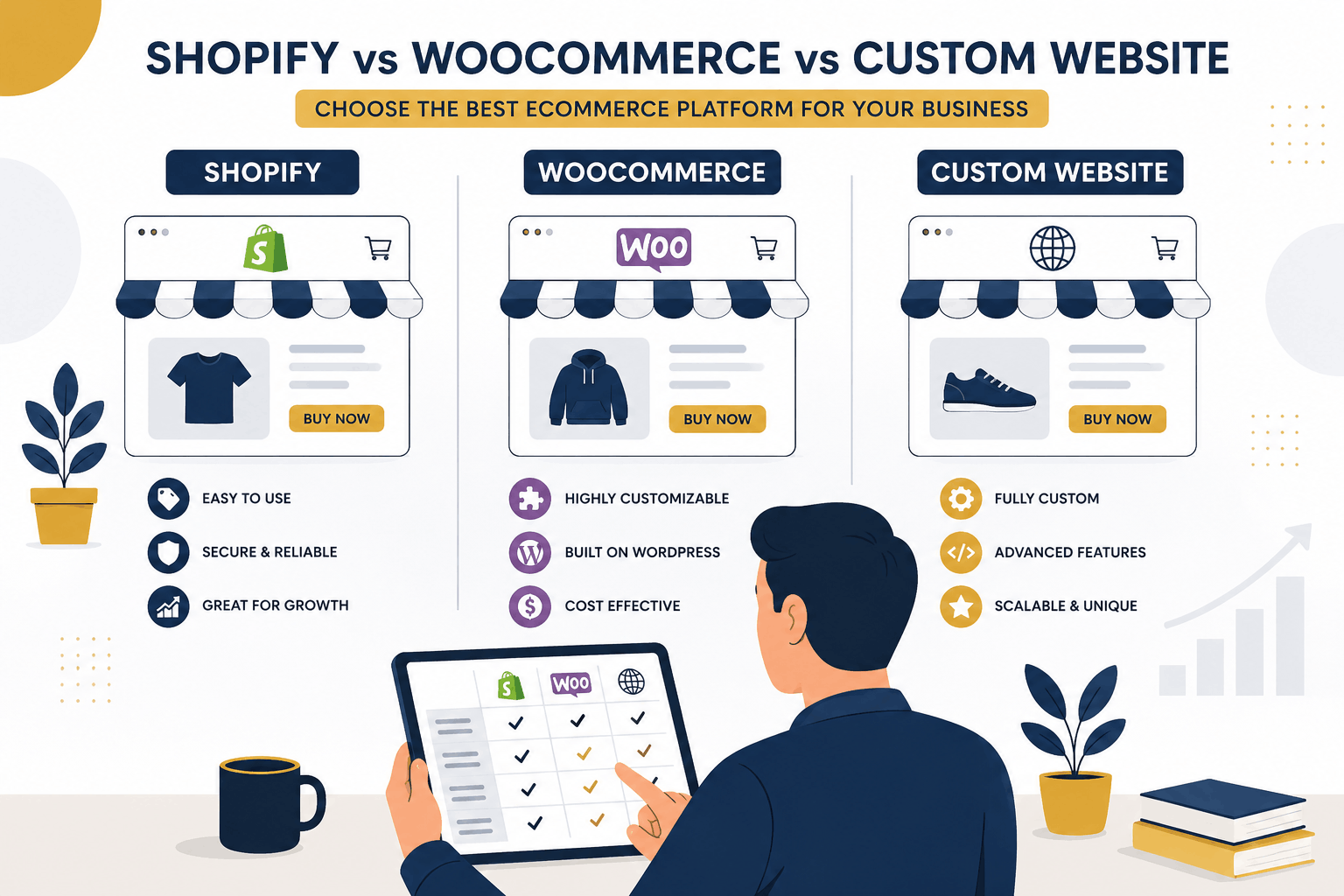
Shopify vs WooCommerce vs Custom eCommerce Website: Which Platform Is Best for Your Business in 2026?
Choosing the wrong ecommerce platform is an expensive mistake — one that shows up months later as slow pages, plugin conflicts, or a checkout your developer can't customize. If you're comparing Shopify vs WooCommerce vs a custom eCommerce website, you're really deciding how much control, speed, and long-term flexibility your business needs versus how much you want to hand off to someone else's system.
This guide breaks down all three options honestly — costs, scalability, SEO performance, and real business scenarios — so you can make a decision you won't regret in 12 months.
Quick Answer
Shopify is best for founders who want to launch fast with minimal technical involvement. WooCommerce suits businesses that already use WordPress and want more control at a lower cost. A custom ecommerce website is the right call once you need unique workflows, heavy scale, or a storefront that competitors can't simply copy from a template. Most growing brands start on Shopify or WooCommerce and migrate to custom only when the platform starts limiting them.
Table of Contents
- What Are Shopify, WooCommerce, and Custom Ecommerce?
- Shopify vs WooCommerce vs Custom: Feature Comparison
- Pricing Comparison (2026)
- Shopify: Pros, Cons, and Best Use Cases
- WooCommerce: Pros, Cons, and Best Use Cases
- Custom Ecommerce: Pros, Cons, and Best Use Cases
- SEO and Performance: Which Platform Wins?
- Real Business Examples
- 2026 Ecommerce Trends Shaping This Decision
- Common Mistakes Businesses Make
- Decision Checklist
- Final Verdict
- FAQs
What Are Shopify, WooCommerce, and Custom Ecommerce?
Shopify is a hosted SaaS platform — you rent the infrastructure and pay monthly for a ready-made store. WooCommerce is a free, open-source plugin that turns WordPress into a store, giving you the code but leaving hosting and security to you. A custom ecommerce website is built from scratch (or on a flexible framework) specifically around your products, workflows, and growth plans, with no built-in ceiling on customization.
The right choice depends less on which platform is "better" in general and more on which one matches your catalog size, technical resources, and three-year growth plan.
Shopify in One Line
A plug-and-play store builder that trades some flexibility for speed and reliability.
WooCommerce in One Line
A cost-effective, highly customizable store built on WordPress, requiring more hands-on management.
Custom Ecommerce in One Line
A fully bespoke platform built for businesses whose needs have outgrown template-based solutions.
Shopify vs WooCommerce vs Custom: Feature Comparison
| Feature | Shopify | WooCommerce | Custom Ecommerce |
| Setup speed | Fast (days) | Moderate (1–3 weeks) | Slower (weeks to months) |
| Hosting | Included | Self-managed | Self-managed or cloud |
| Customization | Limited to apps/theme code | High (open source) | Unlimited |
| Scalability | Good, with plan upgrades | Depends on hosting | Built for your scale |
| Maintenance | Handled by Shopify | Your responsibility | Your team/agency |
| Ownership of code | NO | Yes | Yes |
| Best for | Fast-launch brands | WordPress-native businesses | High-growth, unique-workflow businesses |
| Learning curve | Low | Medium | Depends on build |
Pricing Comparison (2026)
| Cost Factor | Shopify | WooCommerce | Custom Ecommerce |
| Starting monthly cost | ~$39–$105 (plan-based) | $0 (software) + hosting ~$15–$50/mo | Development cost only, no recurring license |
| Transaction fees | Yes, unless using Shopify Payments | None (payment gateway fees only) | None (gateway fees only) |
| Apps/plugins | Often $10–$100+/mo combined | Often $50–$300/mo combined | Built into the platform, no recurring app fees |
| Development cost | Low to moderate | Moderate | Higher upfront investment |
| Long-term cost (3+ years, growing catalog) | Can rise sharply with apps | Moderate, hosting scales with traffic | Often lower per-feature over time |
Expert takeaway: Shopify and WooCommerce look cheaper on day one. Custom ecommerce usually costs more upfront but avoids the compounding app subscriptions and plugin fees that quietly inflate Shopify and WooCommerce bills as a store grows.
Shopify: Pros, Cons, and Best Use Cases
Pros
- Fast to launch, no server management
- Reliable uptime and built-in security
- Large app marketplace for common needs
- Excellent for dropshipping and D2C brands
Cons
- Recurring app costs add up quickly
- Limited backend customization without Shopify Plus
- Checkout customization is restricted on lower plans
- You don't fully own your platform
Best Use Cases: New D2C brands, single-founder businesses, product lines under a few thousand SKUs, teams without in-house developers.
WooCommerce: Pros, Cons, and Best Use Cases
Pros
- Free core software, lower starting cost
- Full access to code and database
- Thousands of plugins for niche functionality
- Great if you already run WordPress content/blog
Cons
- You manage hosting, backups, and security
- Performance depends heavily on hosting quality
- Plugin conflicts can cause bugs as the store grows
- Requires more technical oversight long-term
Best Use Cases: Content-driven brands, businesses already on WordPress, stores needing deep customization without a full custom build, budget-conscious SMEs.
Custom Ecommerce: Pros, Cons, and Best Use Cases
Pros
- No functional ceiling — build exactly what you need
- Full code ownership and data control
- Built for your specific scale, catalog, and integrations
- No recurring app-store fees eating into margins
Cons
- Higher upfront development investment
- Longer build timeline
- Requires a capable development partner
- Ongoing updates need a dedicated team or agency
Best Use Cases: Enterprises, marketplaces, subscription or B2B ecommerce models, businesses with complex pricing/inventory logic, brands wanting a platform competitors can't replicate.
SEO and Performance: Which Platform Wins?
All three platforms can rank well — SEO success depends more on execution than platform choice. That said, there are structural differences worth knowing.
Shopify's URL structure and app-based bloat can limit some technical SEO control. WooCommerce, run on WordPress, offers strong content-SEO flexibility but page speed depends entirely on your hosting and plugin discipline. A custom ecommerce build gives you full control over site architecture, Core Web Vitals, schema markup, and crawl efficiency — which matters more as your catalog and organic traffic grow.
For most small stores, this difference is negligible. For businesses relying heavily on organic search as a growth channel, custom-built or professionally optimized WooCommerce sites tend to outperform default Shopify setups over time — a gap Ebslon Infotech's SEO services and performance marketing teams routinely help close, regardless of which platform a client chooses.
Real Business Examples
- A fashion D2C startup launched on Shopify to validate demand within weeks, then upgraded to Shopify Plus once volume justified the cost.
- A content-heavy home décor brand used WooCommerce to combine blog-driven SEO traffic with product sales on one WordPress site.
- A B2B industrial supplier needed custom pricing tiers, bulk ordering, and ERP integration — no off-the-shelf platform supported this, so a custom ecommerce website was built around their exact workflow.
2026 Ecommerce Trends Shaping This Decision
- Headless and composable commerce is making custom builds more accessible, decoupling the frontend from backend logic.
- AI-powered search and shopping assistants (including AI Overviews and chat-based search) reward fast, well-structured, schema-rich sites — favoring platforms where technical SEO is fully controllable.
- Rising app-subscription costs on SaaS platforms are pushing scaling brands to reconsider custom development sooner than before.
- Mobile-first checkout and one-click payments are now baseline expectations across all three platforms.
Common Mistakes Businesses Make
- Choosing Shopify or WooCommerce purely on price, ignoring future scaling costs.
- Skipping a proper technical SEO setup at launch.
- Over-relying on apps/plugins instead of clean core architecture.
- Building custom too early, before validating product-market fit.
- Underestimating hosting and security needs on WooCommerce.
- Ignoring page speed until traffic and revenue are already affected.
Decision Checklist
Ask yourself:
- [ ] Do I need to launch within days, not months?
- [ ] Will my catalog exceed a few thousand SKUs within 2 years?
- [ ] Do I need custom pricing, B2B logic, or ERP/CRM integration?
- [ ] Is organic SEO a primary growth channel for me?
- [ ] Do I have (or can I hire) an in-house or agency dev team?
- [ ] Am I comfortable with recurring app/plugin subscription costs?
If you checked "yes" to launch speed and low technical involvement — Shopify. If you checked "yes" to WordPress familiarity and moderate customization — WooCommerce. If you checked "yes" to complex workflows, scale, or long-term SEO investment — custom ecommerce.
Expert Recommendation
Start where your current stage demands, not where you hope to be in five years. Most successful ecommerce brands Ebslon Infotech has worked with began on Shopify or WooCommerce, then migrated to a custom ecommerce website once growth, catalog complexity, or integration needs outpaced the platform. Whichever path you choose, invest early in UI/UX design, SEO services, and clean website development — these matter more to long-term revenue than the platform label itself.
Final Verdict
There's no single "best" platform — only the best fit for your current stage. Shopify wins on speed, WooCommerce wins on cost-flexibility, and custom ecommerce wins on long-term control and scale. The smartest move is choosing a development partner who can build correctly on any of the three, and guide you when it's time to migrate.
Conclusion
Deciding between Shopify vs WooCommerce vs a custom eCommerce website comes down to your budget, technical resources, and growth ambitions for 2026 and beyond. Shopify gets you live fast, WooCommerce balances cost and control, and custom development removes every ceiling once you're ready to scale seriously. What matters most isn't the platform logo — it's whether your website, SEO, and user experience are built to convert visitors into customers.
Ready to build the right ecommerce platform for your business? Ebslon Infotech helps startups and enterprises design, develop, and grow on Shopify, WooCommerce, and fully custom ecommerce websites — backed by SEO and performance marketing that actually moves revenue. Talk to our ecommerce experts today and get a free platform recommendation tailored to your business.
FAQs
1. Is Shopify better than WooCommerce in 2026?
Neither is universally "better" — Shopify is faster to launch and easier to maintain, while WooCommerce offers more control at a lower starting cost. The right choice depends on your technical resources and budget.
2. Which is cheaper, Shopify or WooCommerce?
WooCommerce's core software is free, but hosting, plugins, and maintenance can add up. Shopify has predictable monthly fees but often costs more as you add apps.
3. When should I choose a custom ecommerce website instead?
Choose custom development when you need unique workflows, B2B pricing logic, large catalogs, deep integrations, or when app subscription costs on Shopify/WooCommerce are outpacing a custom build's ROI.
4. Is WooCommerce good for large ecommerce stores?
Yes, with proper hosting, caching, and database optimization. Many large stores run successfully on WooCommerce, though performance requires more hands-on management than Shopify.
5. Does platform choice affect SEO rankings?
Platform choice affects technical flexibility, but rankings depend more on execution — content quality, site speed, schema markup, and backlinks matter more than the CMS itself.
6. How much does a custom ecommerce website cost?
Costs vary widely based on features and complexity, generally starting higher than Shopify or WooCommerce upfront but often costing less over 3+ years due to no recurring app fees.
7. Can I migrate from Shopify to a custom website later?
Yes, many businesses start on Shopify or WooCommerce and migrate to custom platforms once they outgrow template limitations — this is a common and often smooth growth path.
8. Is Shopify good for small businesses just starting out?
Yes, Shopify's fast setup and low technical barrier make it ideal for founders validating a new product or business idea.
9. What are the biggest hidden costs of Shopify?
App subscriptions, transaction fees (if not using Shopify Payments), and premium theme costs are the most common hidden expenses.
10. What are the biggest hidden costs of WooCommerce?
Hosting upgrades, premium plugins, developer time for maintenance, and security monitoring are common ongoing costs.
11. Does WooCommerce require coding knowledge?
Basic setup doesn't require coding, but customization beyond standard themes and plugins usually needs a developer.
12. Which platform is best for B2B ecommerce?
Custom ecommerce is typically best for complex B2B needs like tiered pricing, bulk ordering, and ERP integration, though WooCommerce can handle simpler B2B setups with plugins.
13. How long does it take to build a custom ecommerce website?
Timelines vary by scope, typically ranging from a few weeks for a focused build to several months for enterprise-level platforms.
14. Can I use both Shopify/WooCommerce and custom development together?
Yes — some businesses use a headless approach, combining a custom frontend with Shopify or WooCommerce as the backend.
15. Which platform is easiest to scale internationally?
All three can scale internationally, but custom ecommerce offers the most control over multi-currency, multi-language, and region-specific logic without relying on third-party apps.
16. Should I hire an agency or build it myself?
If you lack in-house technical expertise, working with an experienced ecommerce development company reduces costly mistakes and speeds up time-to-launch.
